Connect the Dots
by Rashmi Bansal
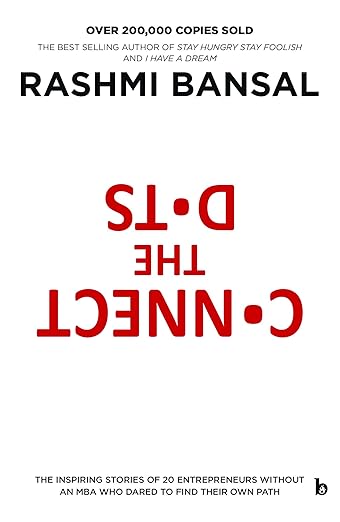
“Connect the Dots” by Rashmi Bansal is a narrative collection of real stories about Indian entrepreneurs who built successful ventures without formal business degrees. Instead of presenting theory or frameworks, the book follows the personal journeys of multiple founders from modest, often non‑metro backgrounds into the risky, uncertain world of entrepreneurship. Each chapter reads like a candid conversation, making complex business decisions feel relatable and human rather than abstract or textbook‑driven.
Bansal organises the entrepreneurs into broad archetypes based on what primarily drives them—passion, purpose, or chance. The “passion” entrepreneurs are those who turned what they loved doing into a venture, refusing to treat interests like music, design, or storytelling as mere hobbies. The “purpose” entrepreneurs are driven by a larger mission, whether social impact, community upliftment, or changing a broken system, and they view business as a vehicle for that mission. The “chance” entrepreneurs stumbled into opportunities more accidentally, but chose to commit, learn, and build around those serendipitous openings.
Across these stories, the book repeatedly shows common patterns: initial resistance from family who prefer safe jobs, lack of capital and networks, and a constant pressure to prove that unconventional paths are not irresponsible. Founders describe starting from one small experiment—like a single class, a tiny shop, or a small project—and then learning sales, operations, hiring, and finance on the go. Many face early failures, poor decisions, or near‑closures, but use those experiences as feedback loops rather than final verdicts, gradually finding product–market fit in the Indian context.
“Connect the Dots” also highlights how opportunity in India often hides in everyday pain points: lack of services in smaller cities, gaps in education or training, underserved customer segments, or cultural shifts among youth. By paying attention to these gaps, the featured entrepreneurs create offerings that feel obvious in hindsight but required courage and independent thinking at the time. The book implicitly argues that entrepreneurship is less about perfect ideas and more about persistence, adaptability, and the willingness to act despite incomplete information.
Overall, the full arc of the book challenges the belief that one needs elite education or foreign exposure to start a business. Through its conversational tone and grounded examples, it encourages readers—especially students, fresh graduates, and early professionals—to see entrepreneurship as a realistic option if they are ready to take small steps, learn continuously, and stay committed to their vision despite social and financial pressure.