Deep Work
by Cal Newport
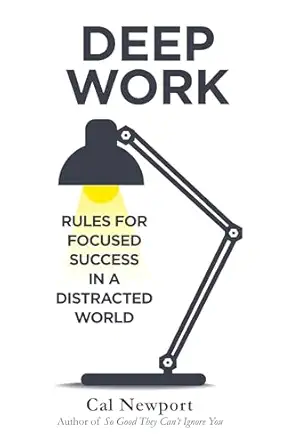
Deep Work: Rules for Focused Success in a Distracted World by Cal Newport is a powerful guide to reclaiming focus in a world overflowing with noise. Newport argues that the ability to concentrate deeply—without distractions—has become one of the most valuable skills of the modern age. Yet, it’s also one of the rarest. Through scientific insights, real-life examples, and practical strategies, Newport makes the case that mastering deep work is essential for producing meaningful results and building a fulfilling life.
At its core, deep work refers to the ability to engage in long, uninterrupted periods of intense concentration. Newport explains that this skill functions much like a muscle: beginners may only manage an hour a day, while experts can reach up to four hours of high-intensity cognitive effort. Despite sounding modest, these four hours often outperform entire days filled with shallow work because depth multiplies productivity. High-quality work, Newport argues, is a simple equation: Quality = Time × Focus. When you raise the intensity of concentration, you dramatically raise output—something thinkers like Carl Jung relied on when producing groundbreaking ideas.
Newport also emphasizes that deep work doesn’t just boost productivity; it increases the meaningfulness of life. Our minds tend to wander, and a wandering mind often leads to anxiety. Focus, on the other hand, pulls us into the present moment. He shares the story of writer Winifred Gallagher, who discovered during her cancer diagnosis that the quality of life is shaped by what we choose to pay attention to. By intentionally directing our focus, we can create a richer, more satisfying life, regardless of circumstances.
Throughout the book, Newport explores how deep work taps into a universal human desire for craftsmanship and purpose. Whether it's a blacksmith forging a Viking sword or an artist perfecting their craft, humans find meaning when pushing their abilities to their limits. Newport cites psychologist Mihaly Csikszentmihalyi’s concept of “flow”—the state of complete immersion in a challenging task—as one of the most fulfilling mental experiences. According to research, people often feel happier in deep engagement than even during leisure. Depth, Newport argues, is not just valuable—it is profoundly satisfying.
To help people cultivate deep work, Newport presents several practical strategies for scheduling and protecting focus. He outlines four philosophies of deep work, suited to different lifestyles. The Monastic approach involves cutting off all distractions entirely—ideal for those who can isolate themselves like monks. The Bimodal philosophy alternates between long stretches of deep work and periods of normal obligations, allowing for intense focus in seasonal bursts. The Rhythmic approach, the most realistic for most people, integrates consistent daily blocks of deep work, building a habit like exercise. Finally, the Journalist strategy involves using any free moment to drop into deep work—a technique suitable only for seasoned practitioners.
Newport warns that without conscious effort, shallow work—emails, notifications, social media, small tasks—will swallow our days and erode our capacity for depth. To counter this, he offers three crucial habits. The first is to reverse the typical pattern of constant distraction. Instead of taking breaks from work to check the internet, Newport recommends taking breaks from focus to check the internet. Scheduled “distraction windows” train the brain to resist impulse. Second, Newport urges readers to embrace boredom. If you cannot be still, you cannot focus. Boredom becomes mental recovery, the antidote to multitasking, and a strengthening exercise for attention. Finally, rituals are essential: consistent times, places, and routines help the brain switch into deep work mode. Equally important is the shutdown ritual, where you end the workday with a clear plan for the next, allowing your mind to truly rest.
In the end, Deep Work is a compelling call to reclaim our attention from the chaos of modern life. Newport shows that by intentionally cultivating focus, reducing shallow distractions, and structuring our days around meaningful work, we can unlock our greatest cognitive potential. Deep work is not just a productivity method—it is a path to clarity, purpose, and excellence in a noisy world.