In Spite of the Gods
by Edward Luce
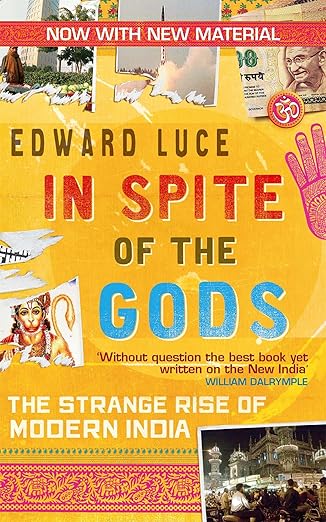
In Spite of the Gods is an incisive, clear-eyed, and richly reported analysis of India written by journalist Edward Luce during his years living and working in the country. The book tries to answer a central puzzle: how has India emerged as one of the world’s most promising rising powers while so many of its internal systems still seem chaotic, unequal, or unresolved? Luce’s answer is contained in the title itself—India is rising not because its systems are flawless, but because its people repeatedly push forward in spite of systemic weight. He paints post-liberalization India as a nation where the private sector has raced ahead at a breathtaking speed: technology hubs like Bangalore and Gurgaon bloom with entrepreneurship, outsourcing transforms the job market, English becomes commercial capital, and a massive young workforce aspires toward global opportunity. Investors, IT companies, call-center economies, software exports, and diaspora capital flows all symbolize economic electricity, an India building new ladders of mobility beyond the village horizons that historically caged opportunity. However, Luce argues that this rise is unevenly distributed, creating islands of world-class success amid oceans of fragile infrastructure, weak public services, bureaucratic drag, and political volatility. He emphasizes that India’s economic story is not just about growth—it is about who is allowed on the growth highway and who remains stuck at the exit ramps.
Luce devotes major sections to India’s social architecture, especially caste, religion, and politics, showing that India must be read through its internal hierarchies and identity negotiations, not only through GDP charts. The caste system, though constitutionally outlawed, remains socially powerful and psychologically inherited, quietly influencing opportunity, networks, marriage, prejudice, and mobility. He portrays caste not as ancient ornament, but as living inertia, which many Indians must push against just to enter modern aspiration arenas. Similarly, religion becomes a double-edged force: India historically benefited from plural spiritual traditions and co-existence, but the rise of Hindu nationalism and sectarian mobilization has electrified politics in a way that deepens emotional fault lines, fuels polarization, and rewrites mythology into political weaponry. The book profiles politicians, corporate leaders, journalists, intelligence insiders, and ideological figures who behave like power networks modeled more on myth and loyalty than institutional neutrality. Luce highlights how coalition governments, fractured state vs center priorities, competitive regional politics, slow legal systems, and overloaded bureaucracy often stall bold national reforms. Yet, unlike military-run countries, India’s democracy has endured—elections keep happening, voices keep arguing, newspapers keep publishing uncomfortable truths, entrepreneurs keep innovating, and ambition continues even when policy execution limps. India, according to Luce, has learned to debate its way forward rather than obey its way forward, making democracy both its strength and its slowdown system, disagreement its oxygen, and endurance its continuity engine.
Luce ends by presenting India not as a harmonious national story, but a nation powered by moral friction, demographic momentum, entrepreneurial impatience, and societal energy that outruns bureaucratic rust. He argues that democracy is noisy but life-preserving, ambition outweighs defeatism, modernization marches without synchronized infrastructure, societies improvise where the state fails to, communities bind stronger than welfare systems, identities are negotiated regionally instead of uniformly, pride grows outwardly faster than reform grows inwardly, English accelerates markets but does not melt caste, corporations scale faster than public institutions, youth innovate faster than bureaucracy executes, reform inertia is large but civic momentum larger, journalists witness suffering while policies quantify it, success rewrites address but not acceptance, and the nation’s real story is carried by millions of Indians who build futures through negotiation rather than permission, rising not because history or institutions cleared the path, but because they kept walking anyway. India’s rise astonishes the world, Luce concludes, not by smooth policy choreography, but by societal improvisation—where the country’s future is less a straight line and more a continuing argument with incremental upward slope, carried by people who refuse to stop rising simply because the landscape keeps interrupting them. The book, therefore, is not just an analysis of modern India—it is an explanation of India’s ascent through paradox, negotiation, friction, and unstoppable human momentum working in spite of its own gods and gatekeepers of delay.