Pachinko
by Min Jin Lee
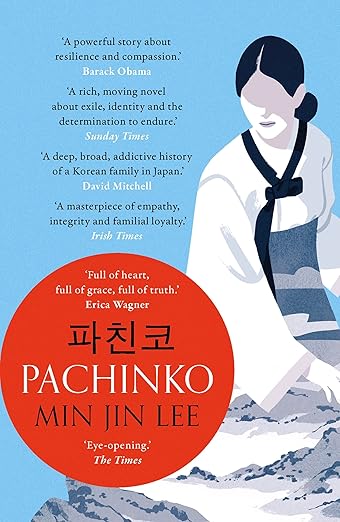
Pachinko is an expansive, deeply emotional, and historically rich family saga that tracks four generations of a Korean family whose lives unfold across two countries, shaped by colonialism, war, forbidden love, migration, institutional discrimination, ambition, shame, sacrifice, identity crisis, and survival. The novel begins in Yeongdo, a small fishing village near Busan in Korea, during Japanese occupation (1910–1945), a time when Korea’s economy is collapsing under colonial rule, and Koreans are treated as inferior subjects in their own homeland. Yangjin, a determined and hardworking young woman, marries Hoonie, a man born with a cleft palate and twisted foot. Despite his physical deformities, Hoonie possesses a rare emotional dignity and kindness. The couple runs a modest boarding house, surviving on routine labor rather than fortune. When Hoonie dies early from tuberculosis, Yangjin continues operating the business alone, raising their only daughter, Sunja, in hardship, but with moral strength, discipline, and sincerity.
As a teenager, Sunja encounters Koh Hansu, a wealthy, charismatic, powerful, and secretive businessman who has strong political connections and deep ties to Japan’s economic machinery. He seduces Sunja—not with romance novels, but with attention, influence, material security, and the illusion of protection. Sunja falls in love, believing Hansu intends to marry her. However, after she becomes pregnant, Hansu reveals that he is already married to a Japanese woman and has no intention of disrupting his established power structure for her. He offers financial support but no legitimacy. Sunja rejects being a kept mistress, choosing dignity over comfort, even in crisis.
Enter Baek Isak, a gentle, sick, educated, and earnest Christian pastor staying at Sunja’s boarding house. Compassion drives Isak to marry her and claim her unborn child as his own, offering her protection not through wealth, but through moral solidarity. Shortly after their marriage, Isak moves with Sunja to Osaka, Japan, initiating the family’s immigrant life. In Japan, Koreans are labelled Zainichi—permanent outsiders who legally belong to Japan but socially exist outside it. They are blocked from equal education, employment, citizenship dignity, cultural status, and even everyday acceptance. Sunja begins working in fish markets, often bonded not by nostalgia but by shared exclusion. Isak, however, is imprisoned by authorities for alleged dissent and later dies in prison due to illness, leaving Sunja and their son Noa (Isak’s adopted child, biologically Hansu’s) along with Mozasu, her second son, to survive alone.
Noa grows up brilliant, studious, and ashamed of his Korean roots in a society that punishes identity. He attends elite schools covertly, hoping education will dissolve prejudice. But when he learns that Hansu is his biological father and involved in organized crime, he experiences unbearable shame. His identity becomes a wound bigger than racism itself. Noa runs away, changes his name, becomes a successful professional, marries, but eventually dies by suicide, proving that discrimination outside can be fought, but self-rejection inside is deadlier.
Mozasu, practical, bold, and emotionally sturdy, chooses a different survival strategy—he builds wealth through pachinko gambling parlors, a business Koreans are allowed to run because it is socially disapproved employment. Through it, he attains financial success, but never social integration. His partner Yumi leaves him, unable to carry instability, but Sunja continues anchoring family continuity. Mozasu fathers Solomon, who carries the new generation’s identity struggles of being global, financially privileged, educated, network-driven, yet still wrestling belonging. Hansu watches from a distance, politically powerful, emotionally present but socially illegitimate, financially supportive but never familial, symbolic of empire built on self-interest rather than legacy.
Across generations, the novel makes a radical argument: History is unfair, opportunity is selective, prejudice is inherited, success does not buy acceptance, nations fail but families survive, lineage carries identity more truthfully than institutions, and survival is built through quiet, ordinary, domestic labor, often carried by women who outlive prejudice even when rewards never arrive. The emotional parallels to India's own partition diaspora, class struggle, inherited duty, discrimination in foreign lands, societal hypocrisy, and matriarch-led survival arcs are why the novel, though Korean in setting, resonates so powerfully in India. The book ends not with closure, but continuation—because like migration, identity, and lineage, the game never ends.